

MEMBER'S LOGINX
| Invalid Username / Password | ||||||||
| Invalid Captcha | ||||||||
|
||||||||
| Sign Up | Forgot Password? | ||||||||
Investment in securities market are subject to market risks. Read all the related documents carefully before investing
LIVE NOW
The Small Cap Proxy Players Briefing
- Home
- Views On News
- Nov 10, 2025 - 5 Fundamentally Strong Penny Stocks
5 Fundamentally Strong Penny Stocks
 Image source: Trifonenko/www.istockphoto.com
Penny stocks, typically trading below Rs 50, represent the smaller end of the equity market and often attract attention for their sharp price movements rather than fundamentals.
Limited analyst coverage and low liquidity add to their risk profile, keeping many investors cautious.
Yet, beneath this volatility, a few companies have built credible businesses with improving earnings, strong governance, and market leadership. These firms may not make headlines, but their consistent execution and balance sheet strength set them apart.
In this editorial, we discuss five such penny stocks with strong fundamentals.
Let's take a look...
#1 Trident
First on the list is Trident.
Trident is one of the largest vertically integrated companies in the home textile industry in India. It's the flagship company of the diversified Trident Group.
It operates as a vertically integrated manufacturer across five major business segments: Yarn, Home Textiles (including Bath & Bed Linen), Paper, Chemicals, and Energy.
The company is one of the largest terry towel manufacturers worldwide, with an annual capacity of 90,000 metric tons (MT). It also offers a range of bed linen products and premium and specialty cotton yarn.
Additionally, Trident is one of the world's largest wheat straw-based paper manufacturers. The company is a leading supplier to the branded copier paper segment in North India, with an installed capacity of 175,000 tonnes per annum.
The company is geographically diversified, with 53% of its total revenue coming from exports in FY25. Its products are sold across over 100 countries, with a bigger presence in the US, UK, Gulf, and India.
India accounted for 47% of revenue, while the rest of the world accounted for 34%. The US accounted for 19% of revenue in FY25, down from 39% in FY24, as higher import duties on textiles weighed on performance.
Revenue declined 2.1% year-on-year (YoY) to Rs 17.1 billion (bn), primarily due to increased exports to non-US markets.
However, profit after tax (PAT) increased 89% to Rs 1.4 bn, due to lower expenses and improved margins.
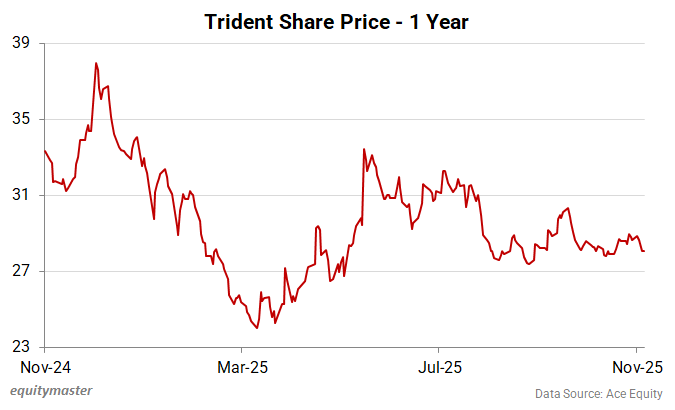
Looking ahead, Trident is making a strategic shift from volume growth to margin-based growth. Trident is also diversifying into non-US markets such as Europe, the Middle East, and Australia.
Trident is well-positioned to benefit from the India-UK FTA, as it's the second-largest exporter of home textiles from India to the UK. The company is also monitoring the potential near-future India-EU FTA.
Strategic expansion is planned for fashion bedding, digital printing, and technical textiles. It aims to capitalise on the improvement in educational printing in India by providing globally recognised wheat straw-based paper.
Check out Trident's factsheet and quarterly results to know more.
#2 Yes Bank
Second on the list is Yes Bank.
Yes Bank is the sixth-largest private sector bank in terms of total assets. The bank offers a wide array of products and services, catering to retail, MSME, and corporate clients across India.
It holds the #1 rank as the UPI Payee Payment Service Provider (PSP) with a 56.9% market share. It's also the #1 Acquiring AePS Bank (Aadhaar Enabled Payment Scheme) with a 39.21% market share.
As of Q2 FY26, the bank's total assets stood at Rs 4.2 trillion (tn) (up 2.6% YoY). Advances grew 6.4% to Rs 2.5 tn, while deposits increased 6.9% to Rs 2.9 tn. The current account savings account (CASA) ratio stood at 33.7%, versus 32% in the same quarter last year.
The credit-deposit ratio stood at 84.5%, lower than 84.8% in Q2 FY25. In advances, the retail sector accounted for 48%, followed by corporate and institutional banking (27%), and the commercial (25%).
Net-interest income surged 4.6% to Rs 23 bn, as net interest margin expanded by 10 bps to 2.5%. PAT increased by 18.3% to Rs 6.5 bn, and operating profit rose by 32.9% to Rs 12.9 bn.
Its asset quality was strong too. Gross non-performing asset (NPA) stood at 1.6% (flat), while net NPA declined to 0.3%. The bank had a return on assets (ROA) of 0.6%.
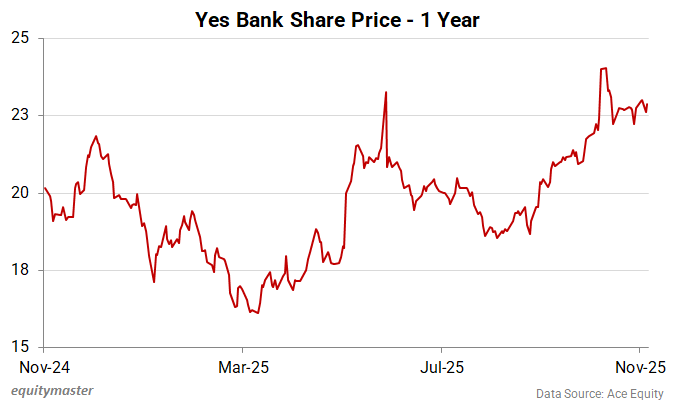
Sumitomo Mitsui Banking Corporation has become the bank's largest shareholder with a 24.2% stake. This transaction was the largest cross-border investment in an Indian private sector bank.
The bank aims to achieve a full-year ROA of 1% by FY27. NIM expansion, lower credit costs, and efficiency gains will drive this expansion.
The NIM expansion in particular is expected to be a key earnings driver, with management anticipating support from the repricing of term deposits, a further decline in RIDF (Rural Infrastructure Development Fund) balances, and potential benefits from any future cash reserve ratio cuts.
The bank projects loan growth of 12-15% for FY26. It expects growth recovery in the retail segment, driven by high-yielding products like digital overdraft for SME customers.
Check out Yes Bank's factsheet and quarterly results to know more.
#3 Fineotex Chemical
Third on the list is Fineotex Chemicals.
Fineotex Chemical is a specialty chemical company. It ranks among the leading producers of tailor-made specialty performance chemicals.
While originally focused on textile chemicals, Fineotex has now diversified its portfolio into high-growth verticals, including cleaning and hygiene, oil and gas, water treatment, and performance chemicals.
It exports to 69 countries and operates with a diversified product portfolio of 470+ product categories. The company has a total manufacturing capacity of 120,000 metric tons per annum (MTPA).
From a financial perspective, revenue declined by 3.5% YoY to Rs 1.4 bn, driven mainly by volume growth. PAT fell by 13.5% to Rs 250 million (m) as margins declined.
Fineotex is strategically shifting its focus to high-growth, adjacent sectors, including oil and gas and water treatment, FMCG, and cleaning and hygiene.
Opportunities in the oil, gas and water treatment are driven by the rising industrialisation, urbanisation, water scarcity, desalination, and the expansion of refineries and natural gas pipelines. The company has added 15,000 MTPA of capacity to meet rising domestic and international demand.
Check out Fineotex Chemical's factsheet and quarterly results to know more.
#4 Infibeam Avenues
Fourth on the list is Infibeam Avenues.
Infibeam Avenues is a global FinTech company and India's first listed FinTech entity. It offers full-stack B2B digital payments solutions, enterprise eCommerce Software Platforms, and lending solutions.
The company has two verticals: Infibeam Focus and Rediff Focus. Infibeam focuses primarily on CCAvenue payments and AI infrastructure. CCAvenue is one of India's most trusted payment gateways, known for deep integrations and regulatory credibility.
The AI ??component is powered by Phronetic.AI, which builds advanced logic models, video large language models, and agentic AI platforms to drive intelligent automation in payments and beyond.
Rediff's focus vertical aims to tap into the growing e-commerce enterprise SaaS (Software-as-a-Service) and productivity solutions market.
This vertical includes RediffOne (enterprise e-commerce suite), Rediff-TV (fully AI-powered content platform) and RediffPay (UPI, tokenised commerce and stablecoins).
The revenue rose 72% YoY to Rs 12.8 bn in Q1FY26, driven by consumer engagement and market penetration. PAT fell 16% to Rs 580 m as margins declined.
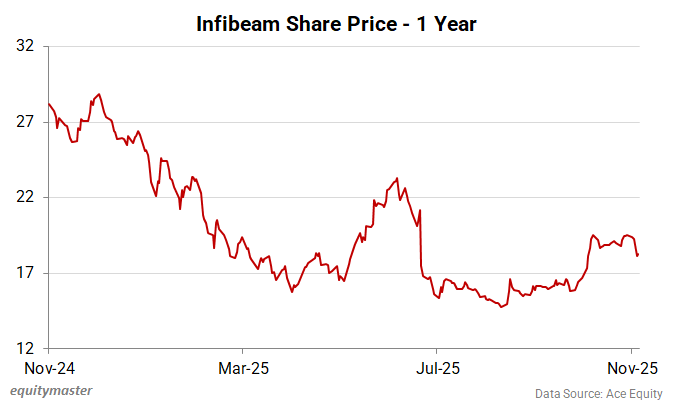
Looking ahead, the e-commerce platform infrastructure business was transferred to Rediff.com for Rs 8 bn. It expects Rediff to achieve a revenue run rate of around Rs 3 bn and surpass Rs 10 bn in annualised revenue within 12 months of the acquisition's completion.
RediffOne was scheduled to launch in Q2FY26 and RediffPay is expected to launch in Q4 of FY26.
Infibeam is also setting up a roadmap for 12 small-city AI-driven data centres (1-2 megawatt each) under the name Infibeam Quantum Edge.
The company employs a customer-centric deployment strategy to ensure high utilisation rates. It plans to achieve its return on investment target within 18-36 months.
International operations are expected to contribute 12-15% of payments net revenue by FY28. The Middle East is a core market. Operations are also expected to commence in the US and Australia in FY27.
Check out Infibeam Avenues' factsheet and quarterly results to know more.
#5 IRB Infrastructure
Fifth on the list is IRB Infrastructure.
IRB Infrastructure is one of India's largest private road and highway integrated infrastructure developer companies, managing highway assets worth over Rs 800 bn.
The company maintains a large portfolio of road assets spanning BOT (Build-Operate-Transfer), TOT (Toll-Operate-Transfer), and HAM (Hybrid Annuity Model) projects.
IRB owns and manages approximately 15,444 lane km of roads across 12 states in India and holds about a 10% market share of pan-India toll revenue. The weighted average residual concession life for its assets is about 21 years.
From a financial standpoint, total income rose 10% to Rs 21.6 bn, driven mainly by the InvITs segment, which grew by 191%. The BOT (+5%) and the construction segment (-2%) remained subdued due to a decrease in construction and project awards. The net profit rose 45% to Rs 2 bn.
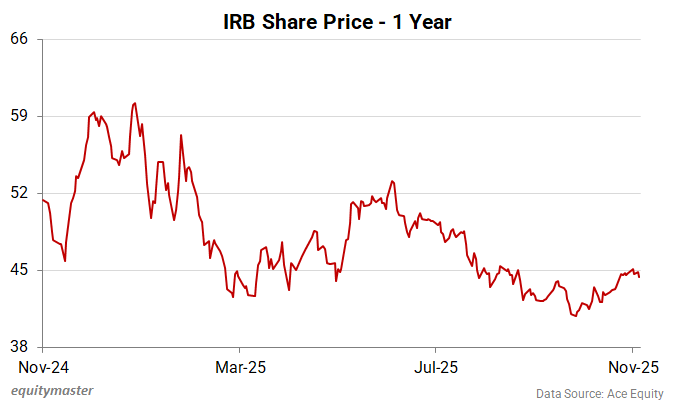
Looking ahead, the company aims to expand its asset base to Rs 1.4 tn over the next three years.
This outlook is centered on the ongoing implementation of its B.E.S.T. strategy (Bid, Execute, Stabilise, and Transfer) to unlock and reinvest capital for new high-potential projects.
In line with this strategy, IRB initiated the transfer of three mature BOT assets from the private InvIT to the Public InvIT. The transaction is expected to release Rs 49 bn, providing IRB the financial lever to bid for projects worth Rs 150 bn.
The total order book stood at Rs 305 bn, with Rs 50 bn of executable pipeline for the next two years.
There is growth on the monetisation front as well. NHAI plans to monetise 24 highway bundles totaling 1,472 km in FY26. This segment could drive growth, as TOT concessions provide access to toll collection and a long-term revenue pipeline. There is also an 871 km project pipeline earmarked for bidding.
Check out IRB Infrastructure factsheet and quarterly results to know more.
Should You Consider Fundamentally Strong Penny Stocks?
While penny stocks are often associated with volatility and speculation, a closer look reveals a few companies that combine scale, execution capability, and financial discipline.
Some companies stand out for their operational metrics, diversified revenue streams, and profitability.
Investors tracking this segment should focus on consistent earnings, balance sheet strength, and management quality to separate fundamentally strong penny stocks from the speculative ones.
Instead of relying only on hype, it is necessary to carefully analyse the company's fundamentals, including financial performance, corporate governance practices, and growth prospects.
Happy investing.
Disclaimer: This article is for information purposes only. It is not a stock recommendation and should not be treated as such. Learn more about our recommendation services here...
ABOUT EQUITYMASTER
Since 1996, Equitymaster has been the source for honest and credible opinions on investing in India. With solid research and in-depth analysis Equitymaster is dedicated towards making its readers- smarter, more confident and richer every day. Here's why hundreds of thousands of readers spread across more than 70 countries Trust Equitymaster.
PREMIUM PRODUCTS
- Hidden Treasure
- Forever Stocks
- Big Wave Profits
- Equitymaster Venture
- Microcap Millionaires
- Momentum Profits
- Double Income
- Midcap Value Alert
- Exponential Profits
- Annual Breakout Alert
- Lazy Millionaire
- Phase One Alert
- InsiderPro Stocks
- StockSelect
- Private Briefing
- Active Wealth Multiplier 2030
- FundSelect
QUICK LINKS
POPULAR TOPICS
- Multibagger Penny Stocks
- Basics of Value Investing
- Benjamin Graham
- How to Invest in Gold
- How to Invest in Silver
- Best Stocks to Buy Today
- Best Small-cap Stocks to Buy
- Best Bluechip Stocks to Buy
- Guide to Penny Stocks
- How to Invest in the Share Market
- Warren Buffett - The Value Investor
- Pick the Best Multibagger Stocks
TRENDING TOPICS
- Best Defence Stocks in India
- Upcoming Dividend Stocks
- Best Semiconductor Stocks in India
- Data Center Stocks in India
- Best Railway Stocks in India
- Best Solar Stocks in India
- Fastest Growing Stocks in India
- List of BSE Sensex 30 Stocks
- Adani Group Shares
- Stocks Recently Bought by FIIs in India
- Top Value Stocks in India


LEGAL DISCLAIMER:
Investment in securities market are subject to market risks. Read all the related documents carefully before investing.
Registration granted by SEBI, enlistment with BSE as IA and RA, and certification from NISM in no way guarantee performance of the intermediary or provide any assurance of returns to investors.
All rights reserved. Any act of copying, reproducing or distributing any content from this website whether wholly or in part, for any purpose without the permission of Quantum Information Services Private Limited is strictly prohibited and shall be deemed to be copyright infringement.
Quantum Information Services Private Limited (QIS) is a SEBI registered Research Analyst (bearing registration no INH000021128) and Investment Adviser(Reg. No: INA000000680). Consequent upon the merger of Equitymaster Research Private Limited into QIS, effective October 30, 2025 QIS owns and operates brand 'Equitymaster' and website www.equitymaster.com. This does not constitute or is not intended to constitute an offer to buy or sell, or a solicitation to an offer to buy or sell financial products, units or securities and QIS including its employees, personnel, directors, associates will not be liable for any losses (direct or indirect) incurred or investment(s) made or decisions taken/or not taken based on the information provided herein. All content and information is provided on an 'As Is' basis by QIS. Information herein is believed to be reliable but QIS does not warrant its completeness or accuracy and expressly disclaims all warranties and conditions of any kind, whether express or implied. The services rendered by QIS are on a best effort basis. QIS does not assure or guarantee the user any minimum or fixed returns. The securities quoted, if any are for illustration only and are not recommendatory. Use of this information is at the user's own risk. The user must make his own investment decisions based on his specific investment objective and financial position and using such independent advisors as he believes necessary. This is not directed for access or use by anyone in a country, especially, USA, Canada or the European Union countries, where such use or access is unlawful or which may subject QIS or its affiliates to any registration or licensing requirement.
The performance data quoted represents past performance and does not guarantee future results. As a condition to accessing QIS's content and website, you agree to our Terms and Conditions of Use, available here
Equitymaster requests your view! Post a comment on "5 Fundamentally Strong Penny Stocks". Click here!
Comments are moderated by Equitymaster, in accordance with the Terms of Use, and may not appear
on this article until they have been reviewed and deemed appropriate for posting.
In the meantime, you may want to share this article with your friends!