

MEMBER'S LOGINX
| Invalid Username / Password | ||||||||
| Invalid Captcha | ||||||||
|
||||||||
| Sign Up | Forgot Password? | ||||||||
Investment in securities market are subject to market risks. Read all the related documents carefully before investing
We're Going On-Air Today:

- Home
- Profit Hunter
- Jun 27, 2025 - Why I'm Bullish on Green Steel Stocks
Why I'm Bullish on Green Steel Stocks
 Image source: Vladimir Zapletin/www.istockphoto.com
I am sure you are familiar with the Tata Steel tagline... 'We also make steel'.
Turns out in 2025 India has extremely critical role in the global steel supply chain.
While global steel capacities have remained unchanged over past few years, India's swift economic growth, along with government's incentives for domestic manufacturing, investments in infrastructure, and rapid urbanization have bolstered steel capacities.
India is currently the second-largest steel producer globally.
But along with the need to meet the required demand, there is also need for sustainable steel production initiatives.
The steel industry is a significant contributor to global carbon dioxide emissions. According to the International Energy Agency (IEA), the iron and steel sector directly accounts for 7% of global energy system emissions.
Imagine the ripple effects of replacing fossil fuels here. It is nothing short of revolutionary.
Think about industries like steel production, cement manufacturing, and long-haul transportation. These heavyweights are tough nuts to crack when it comes to cutting emissions, as electrification is not always practical or cost-effective.
As per Indian Stainless Steel Development Association, domestic steel consumption has registered a growth of 84% over the last five years. Given the role of steel in sectors like manufacturing, defence, infrastructure etc, demand is here to stay.
But as efforts to combat climate change intensify, the quest for clean and sustainable energy solutions has taken centre stage. As the world races towards decarbonisation, the steel industry faces immense pressure to adopt greener production methods.
Enter green hydrogen.
Green hydrogen is hydrogen gas produced through the electrolysis of water, powered entirely by renewable energy sources such as solar and wind.
This carbon-neutral process differentiates green hydrogen from other forms of hydrogen that rely on fossil fuels.
Among the solutions to make steel with less carbon intensity, green hydrogen stands out as a transformative energy source.
In India, where renewable energy is abundant, green hydrogen presents an unparalleled opportunity to lead the clean energy revolution.
As the industry stands at a critical juncture with a dual challenge of reducing the carbon footprint, and keeping production costs in check, India's steel sector plans to keep the middle pathway.
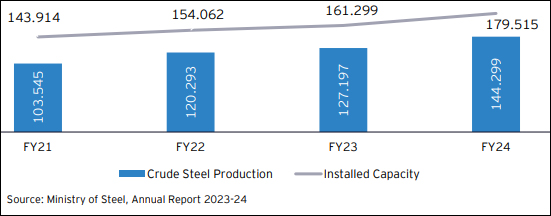
Crude Steel Production
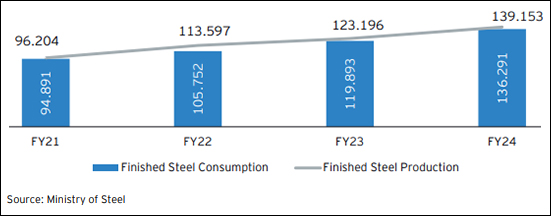
Finished Steel Production
The race to reduce carbon emissions and tackle climate change has brought green hydrogen into the spotlight as a game-changing clean energy solution.
In India, the steel sector accounts for around 12% of the CO2 emissions with an intensity of 2.55 tons of CO2/ ton of crude oil, higher than the global average of 1.85 tons CO2/ton of crude oil.
The Indian steel sector is also split into two producer segments that use different technologies for production.
The first are a handful of integrated producers who can spend more capital on energy-saving technologies, expensive imported natural gas, or upskilling their workforces.
Consequently, they can achieve economies of scale and produce larger amounts of steel from raw materials. These producers are mostly private companies with sizable international presences outside India (e.g. Tata Steel and JSW Steel).
The second are hundreds of medium and small enterprises who each have smaller production capacities. They vary in capacity, profitability, have less trained workers, and cater to regional steel demand.
These producers depend on cheaper, inefficient technologies and domestic coal, increasing their emissions and energy use.
Green steel refers to steel that is produced using environmentally sustainable methods and green hydrogen is one solution that can be used to reduce the sector's carbon footprint significantly.
While India is still in its initial stages of green steel production, the Ministry of Steel has set short, medium, and long-term targets to decarbonise this sector.
By FY35, the expense of producing green steel through the hydrogen direct reduction method is expected to decrease significantly. As per estimates it could end up becoming 26% less costly than in FY24, owing to the anticipated reduction in the price of green hydrogen.
Tata Steel is actively developing green steel initiatives in India, focusing on reducing carbon emissions and adopting sustainable practices.
This includes using biochar to lower emissions in the Jamshedpur plant, investing in a new scrap-based electric arc furnace plant in Ludhiana, and exploring the use of nuclear power for green steel.
The company is building a 7.5 lakh tonne per annum scrap-based electric arc furnace (EAF) plant in Ludhiana, which will be its first low-carbon green steel plant in India. This modern plant will use energy-efficient technology to produce long steel products.
The Indian steel sector is on a trajectory of growth, driven by domestic demand, government policies, and increasing investments. While challenges like raw material security and sustainability remain, the industry is actively addressing them through technological advancements and strategic partnerships.
So, the steel sector's reliance on imported raw materials like nickel, coking coal, and manganese poses a challenge. Strengthening global partnerships and focusing on technological advancements are crucial.
Since commodity stocks tend to be cyclical, investors should have a watchlist of businesses that are both sustainable and profitable. Such stocks can be bought if available at reasonable valuations in the market.
Warm regards,
Tanushree Banerjee
Editor, StockSelect
Equitymaster Research Private Limited (formerly Equitymaster Agora Research Private Limited) (Research Analyst)

Tanushree Banerjee (Research Analyst), is the editor of Stock Select and Forever Stocks. Tanushree started her career at Equitymaster covering the banking and financial sector stocks and scrutinising RBI policies. Over the last decade, she developed Equitymaster's research processes that helped us pick out various multibaggers, across all sectors. A firm believer of "safety first" when it comes to investing, Tanushree closely follows the investing philosophies of Warren Buffett, Jeremy Grantham, and Joel Greenblatt.
ABOUT EQUITYMASTER
Since 1996, Equitymaster has been the source for honest and credible opinions on investing in India. With solid research and in-depth analysis Equitymaster is dedicated towards making its readers- smarter, more confident and richer every day. Here's why hundreds of thousands of readers spread across more than 70 countries Trust Equitymaster.
PREMIUM PRODUCTS
- Hidden Treasure
- Forever Stocks
- Big Wave Profits
- Equitymaster Venture
- Microcap Millionaires
- Momentum Profits
- Double Income
- Midcap Value Alert
- Exponential Profits
- Annual Breakout Alert
- Lazy Millionaire
- Phase One Alert
- InsiderPro Stocks
- StockSelect
- Private Briefing
- Active Wealth Multiplier 2030
- FundSelect
QUICK LINKS
POPULAR TOPICS
- Multibagger Penny Stocks
- Basics of Value Investing
- Benjamin Graham
- How to Invest in Gold
- How to Invest in Silver
- Best Stocks to Buy Today
- Best Small-cap Stocks to Buy
- Best Bluechip Stocks to Buy
- Guide to Penny Stocks
- How to Invest in the Share Market
- Warren Buffett - The Value Investor
- Pick the Best Multibagger Stocks
TRENDING TOPICS
- Best Defence Stocks in India
- Upcoming Dividend Stocks
- Best Semiconductor Stocks in India
- Data Center Stocks in India
- Best Railway Stocks in India
- Best Solar Stocks in India
- Fastest Growing Stocks in India
- List of BSE Sensex 30 Stocks
- Adani Group Shares
- Stocks Recently Bought by FIIs in India
- Top Value Stocks in India


LEGAL DISCLAIMER:
Investment in securities market are subject to market risks. Read all the related documents carefully before investing.
Registration granted by SEBI, enlistment with BSE as IA and RA, and certification from NISM in no way guarantee performance of the intermediary or provide any assurance of returns to investors.
All rights reserved. Any act of copying, reproducing or distributing any content from this website whether wholly or in part, for any purpose without the permission of Quantum Information Services Private Limited is strictly prohibited and shall be deemed to be copyright infringement.
Quantum Information Services Private Limited (QIS) is a SEBI registered Research Analyst (bearing registration no INH000021128) and Investment Adviser(Reg. No: INA000000680). Consequent upon the merger of Equitymaster Research Private Limited into QIS, effective October 30, 2025 QIS owns and operates brand 'Equitymaster' and website www.equitymaster.com. This does not constitute or is not intended to constitute an offer to buy or sell, or a solicitation to an offer to buy or sell financial products, units or securities and QIS including its employees, personnel, directors, associates will not be liable for any losses (direct or indirect) incurred or investment(s) made or decisions taken/or not taken based on the information provided herein. All content and information is provided on an 'As Is' basis by QIS. Information herein is believed to be reliable but QIS does not warrant its completeness or accuracy and expressly disclaims all warranties and conditions of any kind, whether express or implied. The services rendered by QIS are on a best effort basis. QIS does not assure or guarantee the user any minimum or fixed returns. The securities quoted, if any are for illustration only and are not recommendatory. Use of this information is at the user's own risk. The user must make his own investment decisions based on his specific investment objective and financial position and using such independent advisors as he believes necessary. This is not directed for access or use by anyone in a country, especially, USA, Canada or the European Union countries, where such use or access is unlawful or which may subject QIS or its affiliates to any registration or licensing requirement.
The performance data quoted represents past performance and does not guarantee future results. As a condition to accessing QIS's content and website, you agree to our Terms and Conditions of Use, available here
Equitymaster requests your view! Post a comment on "Why I'm Bullish on Green Steel Stocks". Click here!
Comments are moderated by Equitymaster, in accordance with the Terms of Use, and may not appear
on this article until they have been reviewed and deemed appropriate for posting.
In the meantime, you may want to share this article with your friends!