

MEMBER'S LOGINX
| Invalid Username / Password | ||||||||
| Invalid Captcha | ||||||||
|
||||||||
| Sign Up | Forgot Password? | ||||||||
Investment in securities market are subject to market risks. Read all the related documents carefully before investing
We're Going On-Air Today:

- Home
- Profit Hunter
- Nov 26, 2025 - The Anti-Hype Strategy: Your #1 Tool for Financial Success in 2026
The Anti-Hype Strategy: Your #1 Tool for Financial Success in 2026
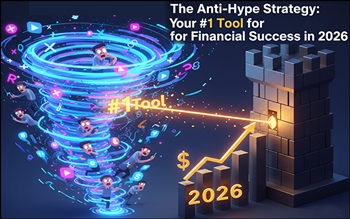 Image source: Google Gemeni
Of all the advice you might receive for navigating the financial markets in 2026, this might sound like the strangest: Significantly reduce your dependence on social media.
You might think I'm joking, but I am serious.
If we are to believe the insights of billionaire investor Cliff Asness, humanity has yet to invent a better engine for transforming the "wisdom of crowds" into the "craziness of mobs" than the very social platforms we use every day.
This idea of "wisdom of crowds" versus "craziness of mobs" is critical to understanding the modern market.
To grasp the positive side, consider a familiar example: the audience poll lifeline on the famous reality show, 'Kaun Banega Crorepati'.
When a contestant is stuck, they can ask the studio audience, and more often than not, the most popular answer is correct. This is the "wisdom of crowds" in its pure, beautiful form.
Why does it work so well?
As Asness points out, the key is independent thought. Each member of that audience thinks for themselves, drawing on their own knowledge.
In this scenario, the wildly wrong answers tend to cancel each other out. One person might guess 'A', another 'C', for reasons known only to them.
Meanwhile, the people who know the right answer all converge on 'B'. The individual errors are filtered away, leaving the collective intelligence of the group to shine through.
It's a powerful demonstration of how a diverse, independent group can arrive at a remarkably accurate solution.
At first glance, you would think the stock market is the perfect place for this wisdom to flourish. It is, after all, one of the largest crowds in the world, with millions of participants buying and selling shares every day.
In an ideal world, all these independent assessments would lead to stock prices that perfectly reflect a company's true, or fair, value. This is the core of the "efficient market hypothesis" that has been taught in business schools for decades.
However, Asness argues that social media has broken this model. It has systematically dismantled the very ingredient that makes crowd wisdom work: Independence.
Today's investors, particularly a new generation, often do not form their views in a vacuum. They log on to platforms like X, Reddit, or YouTube, where they are bombarded with the opinions of influencers, meme-stock gurus, and a chorus of anonymous voices.
Instead of conducting their own research, many simply end up following the herd. They see a stock trending, read a flood of bullish comments, and feel the fear of missing out (FOMO). This creates a situation where people are not making independent judgments; they are echoing a collective sentiment.
The outliers no longer cancel each other out. Instead, they amplify each other, creating a powerful, self-reinforcing wave.
This is where the "wisdom of crowds" curdles into the "craziness of mobs." A mob moves on emotion, not on individual calculation.
In the stock market, this mob psychology causes stock prices to detach violently from their underlying business reality.
We saw this with the meme-stock mania, where companies with shaky fundamentals saw their share prices soar to astronomical heights based on collective enthusiasm and a desire to outsmart traditional Wall Street.
The same dynamic works in reverse, with good companies being punished mercilessly by a negative online narrative.
Instead of making markets more efficient, Asness suggests that social media, thanks to this mob psychology, has made them more inefficient. Prices swing wildly based on sentiment rather than value, creating bubbles and crashes that seem to defy logic.
For the disciplined value investor, this should not be a cause for despair, but for optimism. Value investors have always operated on the belief that the market is not always rational. It frequently veers from fair value because of the innate human tendency to swing between extreme fear and bottomless greed.
What Asness clarifies is that social media acts as an amplifier for these emotions, making these swings wider and more frequent.
This increased inefficiency is not a threat; it is an opportunity. It means there are more chances to buy solid companies when the mob has irrationally beaten down their price and to sell when the mob has pushed their value to unsustainable highs.
So, if you are looking for a single, powerful investment tip for 2026, it's this: Handle social media with extreme care.
This does not mean you must abandon it completely. These platforms can be useful tools for gathering information and reading diverse perspectives. The danger lies in outsourcing your judgment to them.
Do not blindly follow a stock tip from a viral post. Do not accept the crowd's assessment of a company's fair value without doing your own homework.
Use social media for data points, but not for decisions. Your investment choices must be grounded in your own research, logic, and valuation standards.
If your analysis shows that a popular social media stock is wildly overvalued, have the courage to avoid it. Conversely, if you find a gem that the online world is ignoring, have the conviction to invest in it.
This brings us to the timeless wisdom of Warren Buffett, who famously said that the stock market is a device for transferring money from the impatient to the patient.
The social media mob is the very definition of impatience-driven by hype, panic, and the need for instant gratification. It chases quick wins and amplifies short-term noise.
Your strategy, in contrast, must be rooted in patience. By insulating yourself from the daily craziness of the online mob, you can focus on the long-term value of businesses.
You can wait calmly for the market to eventually recognise that value, as it has historically always done.
The rewards will not come from following the hottest trend of the day, but from the steady, disciplined application of your own independent thought.
In the noisy world of 2026, the most revolutionary act an investor can commit is to simply turn down the volume.
Happy investing.
Warm regards,

Rahul Shah
Editor and Research Analyst, Profit Hunter
Quantum Information Services Private Limited (Research Analyst)

Rahul Shah co-head of research at Equitymaster is the editor of (Research Analyst), Editor, Microcap Millionaires, Exponential Profits, Double Income, Midcap Value Alert and Momentum Profits. Rahul has over 20 years of experience in financial markets as an analyst and editor. Rahul first joined Equitymaster as a Research Analyst, fresh out of university in 2003 but left shortly after to pursue his dream job with a Swiss investment bank. However, he quickly became disillusioned working for the 'financial establishment'. He learned first-hand the greedy stereotype of an investment banker is true and became uncomfortable working for a company that put profit above everything else. In 2006, Rahul re-joined Equitymas ter to serve honest, hardworking Indians like his father, who want to take control of their financial future - and not leave it in the hands of greedy money managers. Following the investment principles of Benjamin Graham (the bestselling author of The Intelligent Investor) and Warren Buffet (considered the world's greatest living investor), Rahul has recommended some of the biggest winners in Equitymaster's history.
ABOUT EQUITYMASTER
Since 1996, Equitymaster has been the source for honest and credible opinions on investing in India. With solid research and in-depth analysis Equitymaster is dedicated towards making its readers- smarter, more confident and richer every day. Here's why hundreds of thousands of readers spread across more than 70 countries Trust Equitymaster.
PREMIUM PRODUCTS
- Hidden Treasure
- Forever Stocks
- Big Wave Profits
- Equitymaster Venture
- Microcap Millionaires
- Momentum Profits
- Double Income
- Midcap Value Alert
- Exponential Profits
- Annual Breakout Alert
- Lazy Millionaire
- Phase One Alert
- InsiderPro Stocks
- StockSelect
- Private Briefing
- Active Wealth Multiplier 2030
- FundSelect
QUICK LINKS
POPULAR TOPICS
- Multibagger Penny Stocks
- Basics of Value Investing
- Benjamin Graham
- How to Invest in Gold
- How to Invest in Silver
- Best Stocks to Buy Today
- Best Small-cap Stocks to Buy
- Best Bluechip Stocks to Buy
- Guide to Penny Stocks
- How to Invest in the Share Market
- Warren Buffett - The Value Investor
- Pick the Best Multibagger Stocks
TRENDING TOPICS
- Best Defence Stocks in India
- Upcoming Dividend Stocks
- Best Semiconductor Stocks in India
- Data Center Stocks in India
- Best Railway Stocks in India
- Best Solar Stocks in India
- Fastest Growing Stocks in India
- List of BSE Sensex 30 Stocks
- Adani Group Shares
- Stocks Recently Bought by FIIs in India
- Top Value Stocks in India


LEGAL DISCLAIMER:
Investment in securities market are subject to market risks. Read all the related documents carefully before investing.
Registration granted by SEBI, enlistment with BSE as IA and RA, and certification from NISM in no way guarantee performance of the intermediary or provide any assurance of returns to investors.
All rights reserved. Any act of copying, reproducing or distributing any content from this website whether wholly or in part, for any purpose without the permission of Quantum Information Services Private Limited is strictly prohibited and shall be deemed to be copyright infringement.
Quantum Information Services Private Limited (QIS) is a SEBI registered Research Analyst (bearing registration no INH000021128) and Investment Adviser(Reg. No: INA000000680). Consequent upon the merger of Equitymaster Research Private Limited into QIS, effective October 30, 2025 QIS owns and operates brand 'Equitymaster' and website www.equitymaster.com. This does not constitute or is not intended to constitute an offer to buy or sell, or a solicitation to an offer to buy or sell financial products, units or securities and QIS including its employees, personnel, directors, associates will not be liable for any losses (direct or indirect) incurred or investment(s) made or decisions taken/or not taken based on the information provided herein. All content and information is provided on an 'As Is' basis by QIS. Information herein is believed to be reliable but QIS does not warrant its completeness or accuracy and expressly disclaims all warranties and conditions of any kind, whether express or implied. The services rendered by QIS are on a best effort basis. QIS does not assure or guarantee the user any minimum or fixed returns. The securities quoted, if any are for illustration only and are not recommendatory. Use of this information is at the user's own risk. The user must make his own investment decisions based on his specific investment objective and financial position and using such independent advisors as he believes necessary. This is not directed for access or use by anyone in a country, especially, USA, Canada or the European Union countries, where such use or access is unlawful or which may subject QIS or its affiliates to any registration or licensing requirement.
The performance data quoted represents past performance and does not guarantee future results. As a condition to accessing QIS's content and website, you agree to our Terms and Conditions of Use, available here
Equitymaster requests your view! Post a comment on "The Anti-Hype Strategy: Your #1 Tool for Financial Success in 2026". Click here!
Comments are moderated by Equitymaster, in accordance with the Terms of Use, and may not appear
on this article until they have been reviewed and deemed appropriate for posting.
In the meantime, you may want to share this article with your friends!