

MEMBER'S LOGINX
| Invalid Username / Password | ||||||||
| Invalid Captcha | ||||||||
|
||||||||
| Sign Up | Forgot Password? | ||||||||
Investment in securities market are subject to market risks. Read all the related documents carefully before investing
We're Going On-Air Today:

- Home
- Views On News
- Nov 28, 2025 - Why GAIL Share Price is Falling
Why GAIL Share Price is Falling
 Image source: Lemon_tm/www.istockphoto.com
The energy sector in India is vast and diverse. It includes oil and gas exploration companies, refiners and marketers, coal miners, power generators, and renewable energy players.
Over the past three months, the sector has been on a strong upward trend. The S&P BSE Energy Index has risen 9.1% during this period.
Within this broader rally, most major energy stocks have participated in the uptrend - but not all of them have moved in the same way.
GAIL, one of the key constituents of the index, has lagged behind. While the index gained nearly 9.1%, GAIL's stock has inched up by only 1.1%.
Even today, shares of Maharatna PSU GAIL (India) slipped sharply, falling 6.5% in early trade on Friday, 28 November.
Here's why the stock of this PSU giant tumbled in today's session.
# Lower than Expected Transmission Tariff Revision
GAIL's shares fell over 6% in early trade on Friday, 28 November, after PNGRB finally released its long-pending transmission tariff revision late last evening.
While the tariff has been increased, the final outcome was meaningfully lower than what GAIL had expected.
Under the new order, the transmission tariff has been revised to Rs 65.7 per MMBtu, up from Rs 58.6 per MMBtu, marking a 12% hike. However, this is still well below the Rs 78 per MMBtu that the company had sought.
| Particulars | Earlier Tariff | Revised Tariff | What GAIL Expected |
|---|---|---|---|
| Transmission Tariff (Rs /MMBtu) | 58.6 | 65.7 | 78 |
The PNGRB order also mentioned that critical components such as actual and future capex, operating expenditure, transmission loss, working days, and revenue-sharing adjustments will be addressed only in the next tariff review, scheduled for FY 2028, with implementation from 1 April 2028.
In a CNBC-TV18 interaction, GAIL's management highlighted that this tariff hike will add Rs 12 billion (bn) to transmission EBITDA in the current year, and around Rs 13.5 bn next year.
However, the lower-than-expected tariff means the company's earlier EBITDA estimates for FY27-28 will now need to be moderated.
Why this Tariff Matters for GAIL?
The tariff outcome is crucial for GAIL because its extensive pipeline network handles nearly 90% of India's natural gas volumes. With operating and maintenance costs rising steadily, a stronger tariff increase was essential to support earnings and margins.
Moreover, the regulator has approved tariff implementation from 1 January 2026, instead of GAIL's request for 1 January 2025.
This delay, combined with the lower-than-expected hike, weighed heavily on market sentiment - ultimately causing the stock's sharp fall in today's trade.
What next?
Going forward, GAIL (India) is set to undertake several major expansion initiatives to strengthen its gas and LPG infrastructure across the country.
The company has approved a significant capacity expansion of the Jamnagar-Loni LPG pipeline, doubling its throughput from 3.25 MMTPA to 6.5 MMTPA.
The enhanced pipeline, spanning 1,107 km and costing around Rs 53.5 bn, will run through Gujarat, Rajasthan, Haryana, Delhi and Uttar Pradesh, enabling safer and more efficient LPG supply across these regions.
GAIL has also cleared the development of a 114 km natural gas spur line connecting its Vijaipur plant to BPCL's Bina refinery in Madhya Pradesh. Valued at Rs 4.5 bn, this project aligns with the refinery's ongoing capacity expansion and the addition of a new petrochemical unit.
In the clean energy space, the company has sanctioned a 20-tonne-per-day compressed biogas (CBG) plant in Sultanpur, Uttar Pradesh. Using agricultural feedstock, the unit will produce 88 tonnes of fermented organic manure (FOM) daily, supporting both renewable energy and sustainable farming.
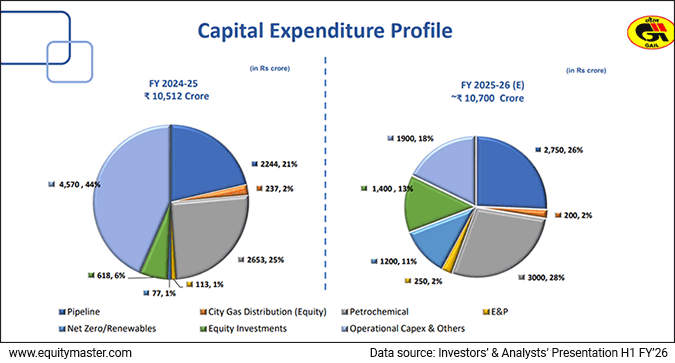
On the capital expenditure front, GAIL plans to maintain a steady outlay of Rs 105-107 bn across FY25 and FY26.
The bulk of this spending will continue to be directed toward expanding its pipeline network and petrochemical capacity, while city gas distribution equity, E&P, renewables and operational capex will receive smaller allocations.
FY26 will also see a gradual scaling up of investments in net-zero and renewable initiatives, reinforcing GAIL's long-term shift toward cleaner energy solutions.
How shares of GAIL have performed recently
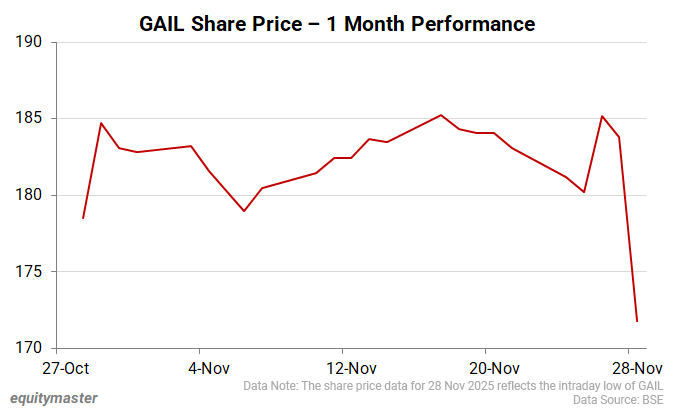
GAIL's shares are trading around Rs 174 intraday on 28 Nov 2025, after hitting an early trade low of Rs 171.8. Over the past five days, the stock has declined by 4%.
The company touched its 52-week high of Rs 213 on 6 December 2024 and its 52-week low of Rs 150 on 4 March 2025.
About GAIL
GAIL (India) is a New Delhi-based natural gas processing and distribution company operating across India and internationally. Its businesses span natural gas transmission and marketing, petrochemicals, LPG and other liquid hydrocarbons, and renewable power.
Additionally, GAIL produces LPG, propane, pentane, naphtha, fuel oil, and polymers like HDPE and LLDPE under the G-Lex and G-Lene brands, and generates energy through wind and solar assets.
Investors should evaluate the company's fundamentals, corporate governance, and valuations of the stock as key factors when conducting due diligence before making investment decisions.
For more details about the company, you can have a look at the GAIL fact sheet and quarterly results on our website.
To know what's moving the Indian stock markets today, check out the most recent share market updates here.
Happy Investing.
Disclaimer: This article is for information purposes only. It is not a stock recommendation and should not be treated as such. Learn more about our recommendation services here...
ABOUT EQUITYMASTER
Since 1996, Equitymaster has been the source for honest and credible opinions on investing in India. With solid research and in-depth analysis Equitymaster is dedicated towards making its readers- smarter, more confident and richer every day. Here's why hundreds of thousands of readers spread across more than 70 countries Trust Equitymaster.
PREMIUM PRODUCTS
- Hidden Treasure
- Forever Stocks
- Big Wave Profits
- Equitymaster Venture
- Microcap Millionaires
- Momentum Profits
- Double Income
- Midcap Value Alert
- Exponential Profits
- Annual Breakout Alert
- Lazy Millionaire
- Phase One Alert
- InsiderPro Stocks
- StockSelect
- Private Briefing
- Active Wealth Multiplier 2030
- FundSelect
QUICK LINKS
POPULAR TOPICS
- Multibagger Penny Stocks
- Basics of Value Investing
- Benjamin Graham
- How to Invest in Gold
- How to Invest in Silver
- Best Stocks to Buy Today
- Best Small-cap Stocks to Buy
- Best Bluechip Stocks to Buy
- Guide to Penny Stocks
- How to Invest in the Share Market
- Warren Buffett - The Value Investor
- Pick the Best Multibagger Stocks
TRENDING TOPICS
- Best Defence Stocks in India
- Upcoming Dividend Stocks
- Best Semiconductor Stocks in India
- Data Center Stocks in India
- Best Railway Stocks in India
- Best Solar Stocks in India
- Fastest Growing Stocks in India
- List of BSE Sensex 30 Stocks
- Adani Group Shares
- Stocks Recently Bought by FIIs in India
- Top Value Stocks in India


LEGAL DISCLAIMER:
Investment in securities market are subject to market risks. Read all the related documents carefully before investing.
Registration granted by SEBI, enlistment with BSE as IA and RA, and certification from NISM in no way guarantee performance of the intermediary or provide any assurance of returns to investors.
All rights reserved. Any act of copying, reproducing or distributing any content from this website whether wholly or in part, for any purpose without the permission of Quantum Information Services Private Limited is strictly prohibited and shall be deemed to be copyright infringement.
Quantum Information Services Private Limited (QIS) is a SEBI registered Research Analyst (bearing registration no INH000021128) and Investment Adviser(Reg. No: INA000000680). Consequent upon the merger of Equitymaster Research Private Limited into QIS, effective October 30, 2025 QIS owns and operates brand 'Equitymaster' and website www.equitymaster.com. This does not constitute or is not intended to constitute an offer to buy or sell, or a solicitation to an offer to buy or sell financial products, units or securities and QIS including its employees, personnel, directors, associates will not be liable for any losses (direct or indirect) incurred or investment(s) made or decisions taken/or not taken based on the information provided herein. All content and information is provided on an 'As Is' basis by QIS. Information herein is believed to be reliable but QIS does not warrant its completeness or accuracy and expressly disclaims all warranties and conditions of any kind, whether express or implied. The services rendered by QIS are on a best effort basis. QIS does not assure or guarantee the user any minimum or fixed returns. The securities quoted, if any are for illustration only and are not recommendatory. Use of this information is at the user's own risk. The user must make his own investment decisions based on his specific investment objective and financial position and using such independent advisors as he believes necessary. This is not directed for access or use by anyone in a country, especially, USA, Canada or the European Union countries, where such use or access is unlawful or which may subject QIS or its affiliates to any registration or licensing requirement.
The performance data quoted represents past performance and does not guarantee future results. As a condition to accessing QIS's content and website, you agree to our Terms and Conditions of Use, available here
Equitymaster requests your view! Post a comment on "Why GAIL Share Price is Falling". Click here!
Comments are moderated by Equitymaster, in accordance with the Terms of Use, and may not appear
on this article until they have been reviewed and deemed appropriate for posting.
In the meantime, you may want to share this article with your friends!