

MEMBER'S LOGINX
| Invalid Username / Password | ||||||||
| Invalid Captcha | ||||||||
|
||||||||
| Sign Up | Forgot Password? | ||||||||
Investment in securities market are subject to market risks. Read all the related documents carefully before investing
We're Going On-Air Today:

- Home
- Outlook Arena
- Best Infrastructure Stocks in India
Best Infrastructure Stocks in India
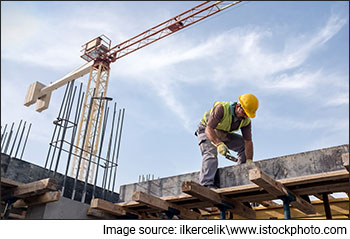
The infrastructure sector in India is an important driver of the country's economic growth.
Given that roads, railways, metros, etc. are an integral part of enhancing the productivity and operations of businesses, robust infrastructure is a must.
However, despite being one of the fastest-growing economies in the world, India is lagging behind the rest of the world with respect to infrastructure development.
To change this, the government of India has been taking various measures in recent years.
Resultantly, the tide has turned after a long time for infrastructure stocks. There's massive capex lined up backed by government's announcements on the production linked incentive (PLI) schemes.
An important thing here is that the benefits of the capex cycle will not be limited to infra sector. Think of the additional cement and steel required to build roads, highways, hospitals, and buildings.
A push to the infra sector directly lifts the gross domestic product (GDP) growth because infrastructure investment has a multiplier effect.
With a steadily rising population, the economy needs a massive amount of spending on constructing new infrastructure and rebuilding the aging assets to meet the needs.
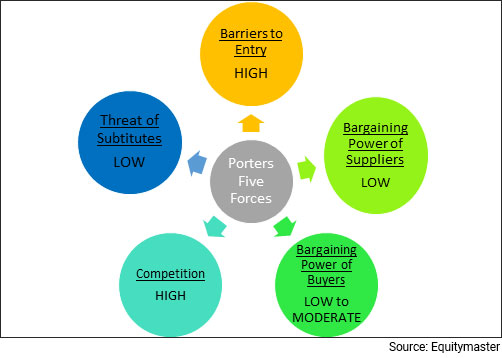
Porter's Five Forces Analysis of the Infrastructure Sector in India
Porter's Five Forces is a model that identifies and analyzes five competitive forces that shape every industry.
These are barriers to entry, bargaining power of suppliers, bargaining power of customers, threat of substitutes and competition within the industry.
A change in any of the forces normally requires a company to re-assess the marketplace.
Let us have a look at how these five forces shape the infrastructure sector -
#1 Barriers to Entry
The most attractive segment is one in which barriers to entry are high as they restrict the threat of new entrants.
Conversely if the barriers are low, the risk of new companies venturing into a given market is high.
In the infrastructure sector, barriers to entry are high, considering the capital intensive nature of the industry and reputation attached to the existing players.
#2 Bargaining Power of Suppliers
The bargaining power of customers is the ability of suppliers to put the firm under pressure. Suppliers may refuse to work with the firm or charge excessively high prices for unique resources.
This is low in the infrastructure industry, because of intense competition amongst them. However, in technology driven high-end segments, suppliers have the upper hand.
#3 Bargaining Power of Customers
The bargaining power of customers is the ability of customers to put the firm under pressure. It is high if buyers have many alternatives and low if they have few choices.
This is low in technology oriented segments. However, fierce competition in power generation and transmission equipment has increased bargaining power of customers.
#4 Competition
For most industries, having an understanding of the competition is vital to successfully marketing a product.
The competition in infrastructure sector is intense among major players. Companies compete on pricing, experience in a particular field, product quality, and capability of handling projects.
However, small companies are trying to revamp their scale and size.
#5 Threat of Substitutes
A substitute product uses a different technology to try to solve the same economic need.
This is low in the infra sector due to the nature of the industry. If a buyer wants to revamp or renovate its existing stock, it is likely to go to the same players.
Porters Five Forces Analysis of the Infrastructure Sector in India
When to Invest in Infrastructure Stocks
Infrastructure stocks are usually risker as their fortunes are prone to economic booms and busts and for this reason, they are often called cyclical stocks.
Generally considered an offensive tactic in investing, cyclical stocks can be used to generate high returns when the economy is doing well.
Therefore, the best time to buy such stocks is at the start of an economic expansion and the best time to sell them is just before the economy begins to slow down. However, before selecting a stock, one must check whether the industry is due for revival or not.
Key Points to Keep in Mind While Investing in Infrastructure Stocks
Here are some key points to take note of before you invest in infra stocks.
#1 Cyclicality risk
An industry cycle is characterized by an upturn as well as downturn. Cyclical businesses do well during an industry upturn and vice versa.
On the other hand, there are some businesses that are not very cyclical. These businesses are immune to changes in industry cycles in the sector and have less risk. In short, if the business is cyclical, higher is the risk.
Infra companies' operations are linked to spending by the government on infrastructure and the expansion plan a company undertakes.
As a result, during times of distress in the Indian economy, government can cut down on investments in infrastructure spending. This can have an adverse impact on infra companies' operations.
To mitigate this risk at certain extent, you could look at companies who have decent export revenues.
#2 Order book
You know it's a good time to invest in infra stocks when all infrastructure-focused firms experience strong order inflows. This could be due to government's big push or any other particular reason.
If the order book position of infra players is adequate, it provides near term revenue visibility.
Along with order book, also check the company's history of execution capabilities and whether it is able to execute at higher pace than others.
#3 Interest rates
For any infra company, interest rate is a big lever for earnings growth because in most cases, they are dependent on borrowed funds.
Infra companies will be able to grow their earnings at a faster pace when there's a reduction in interest rates.
#4 Profitability of the company
Profitability is the primary goal of all business ventures. Without profitability the business will not survive in the long run. So, measuring current and past profitability and projecting future profitability is very important.
Here's a list of top infrastructure companies in India based on their consolidated net profit.
| Rs m, consolidated | Profit After Tax | PAT Margin (%) |
|---|---|---|
| Larsen & Toubro Ltd. | 78,795 | 8% |
| Rail Vikas Nigam Ltd. | 10,872 | 6% |
| GR Infraprojects Ltd. | 7,608 | 10% |
| Ircon International Ltd. | 5,443 | 8% |
| Kalpataru Power Transmission Ltd. | 5,154 | 7% |
| NCC Ltd. | 4,901 | 5% |
| PNC Infratech Ltd. | 4,478 | 7% |
| KEC International Ltd. | 4,344 | 3% |
| KNR Constructions Ltd. | 3,818 | 12% |
| H.G. Infra Engineering Ltd. | 3,388 | 9% |
Data as of March 2022
#5 Debt to equity (D/E) ratio
A company uses both equity and debt to run a business. However, the amount of debt it uses indicates its fixed obligations. Higher the leverage, higher will be the fixed charges such as interest expense which will lower the profitability.
One must look for a debt to equity ratio of one or less than one.
Here's a list of top infrastructure companies in India with a low debt to equity ratio.
| Rs m, consolidated | Debt to Equity (x) | Interest Coverage (x) |
|---|---|---|
| Ircon International Ltd. | 0.00 | 4.21 |
| KNR Constructions Ltd. | 0.00 | 19.99 |
| Likhitha Infrastructure Ltd. | 0.00 | 110.66 |
| PNC Infratech Ltd. | 0.06 | 8.88 |
| NCC Ltd. | 0.20 | 2.32 |
| J Kumar Infraprojects Ltd. | 0.21 | 3.83 |
| Nelco Ltd. | 0.21 | 5.96 |
| H.G. Infra Engineering Ltd. | 0.23 | 9.60 |
| GR Infraprojects Ltd. | 0.25 | 8.72 |
| Larsen & Toubro Ltd. | 0.30 | 5.66 |
Data as of March 2022
#6 Return on Capital Employed (ROCE) ratio
Along with a low debt to equity ratio, a one must look for a high return on capital employed (ROCE).
Return on capital employed measures how much profits the company is generating through its capital. The higher the ratio, the better.
An ROCE of above 15% is considered decent for companies that are in an expansionary phase.
Here's a list of top infrastructure companies in India with more than 15% in ROCE. We have also provided their return on equity (ROE) and return on assets (ROA).
| ROCE (%) | |
|---|---|
| Likhitha Infrastructure Ltd. | 35.3 |
| H.G. Infra Engineering Ltd. | 33.8 |
| KNR Constructions Ltd. | 29.6 |
| GR Infraprojects Ltd. | 21.7 |
| Techno Electric & Engineering Company Ltd. | 19.1 |
| Salasar Exteriors & Contour Ltd. | 17.6 |
| Rail Vikas Nigam Ltd. | 17.0 |
| KEC International Ltd. | 16.8 |
| Kalpataru Power Transmission Ltd. | 16.2 |
| Nelco Ltd. | 16.2 |
Data as of March 2022
#7 Valuations
Investing in stocks requires careful analysis of financial data to find out a company's true worth. However, an easier way to find out about a company's performance is to look at its financial ratios.
Being an asset heavy and cyclical business, the commonly used financial ratios used in the valuation of infrastructure stocks are -
Price to Book Value Ratio (P/BV) - It compares a firm's market capitalization to its book value. A high P/BV indicates markets believe the company's assets to be undervalued and vice versa.
To find stocks with favorable P/BV Ratios, check out our list of stocks according to their P/BV Ratios.
Price to Earnings Ratio (P/E) - It compares the company's stock price with its earnings per share. The higher the P/E ratio, the more expensive the stock.
To find stocks with favorable P/E Ratios, check out our list of stocks according to their P/E Ratios.
#8 Dividend yields
There is no consistent trend of dividends across the industry, with different companies having different dividend policies.
Here's a list of top infrastructure companies in India making healthy dividend payouts.
| Dividend per share (Rs) | Dividend Payout (%) | |
|---|---|---|
| Nirlon Ltd. | 26 | 211.5 |
| Ircon International Ltd. | 2.5 | 43.2 |
| Rail Vikas Nigam Ltd. | 1.8 | 35.1 |
| NCC Ltd. | 2 | 24.9 |
| J Kumar Infraprojects Ltd. | 3 | 11 |
| Kalpataru Power Transmission Ltd. | 6.5 | 18.8 |
| Larsen & Toubro Ltd. | 22 | 39.2 |
| Man InfraConstruction Ltd. | 1.3 | 44.3 |
| Indian Hume Pipe Company Ltd. | 2 | 16.8 |
| KEC International Ltd. | 4 | 23.7 |
Data as of March 2022
For more details, check out the top stocks offering high dividend yields.
Top Infrastructure Stocks in India
Here are the top infrastructure stocks in India which score well on crucial parameters.
#1 L&T
#2 Siemens
#3 ABB India
#4 Tube Investments of India
#5 BHEL
For more details on infra stocks, check out Equitymaster's Powerful stock screener for filtering the best infra stocks in India.
List of Infrastructure Stocks in India
The details of listed infra companies can be found on the NSE and BSE website. However, the overload of financial information on these websites can be overwhelming.
For a more direct and concise view of this information, you can check out our list of infra stocks.
Best Sources for Information on the Infrastructure Sector
India Brand Equity Foundation (IBEF) Infra sector report - https://www.ibef.org/industry/infrastructure-sector-india
National Infrastructure Pipeline - https://indiainvestmentgrid.gov.in/national-infrastructure-pipeline
So, there you go. Equitymaster's detailed guide on the top infra stocks in India is simple and easy to understand. At the same time, it offers detailed analysis of both the sector and the top stocks in the sector.
Here's a list of articles and videos on the infra sector and top infra stocks in India. This is a great starting point for anyone who is looking to explore more about infra stocks and the infra sector.
Disclaimer: This article is for information purposes only. It is not a stock recommendation and should not be treated as such. Learn more about our recommendation services here...
![]() Is L&T Undervalued Post Correction? Key Metrics to Watch
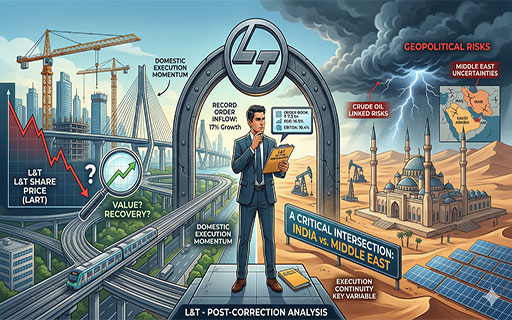
Is L&T Undervalued Post Correction? Key Metrics to Watch
Mar 21, 2026
Strong order book drives growth, but geopolitical risks in the Middle East could challenge near-term visibility.
![]() 5 Mutual Funds Invested in Drone Stocks
5 Mutual Funds Invested in Drone Stocks

Mar 14, 2026
A look at five mutual funds investing in companies linked to India's emerging drone ecosystem.
![]() 5 Stocks Riding the Power Transmission and BESS Wave
5 Stocks Riding the Power Transmission and BESS Wave
Mar 12, 2026
Here are five power sector stocks to watch amid growing transmission infrastructure and accelerating BESS deployment.
![]() 3 Mutual Funds Riding the Semiconductor Boom
3 Mutual Funds Riding the Semiconductor Boom

Mar 10, 2026
In this video, we explain why semiconductors have become one of the most important building blocks of the global economy and 3 mutual funds that focus on the semiconductor ecosystem.
![]() AI Disrupts IT - A Smallcap Value Migration Opportunity?
AI Disrupts IT - A Smallcap Value Migration Opportunity?

Mar 6, 2026
While the world debates AI software, massive global infrastructure shifts are creating a unique tailwind for a specific, listed hardware play. Here's why the 'old' human hours model is losing ground to physical computing.
![]() Metals Are Back? 3 Funds You Should Know
Metals Are Back? 3 Funds You Should Know

Mar 2, 2026
In this video, we explain why industrial metals like copper, aluminium, zinc and iron ore are returning to investment discussions.
![]() Top 3 Power Stocks to Watch as Data Center Demand Fuels Power Growth
Top 3 Power Stocks to Watch as Data Center Demand Fuels Power Growth

Feb 23, 2026
In 2026, the data center industry has shifted from a background infrastructure concern to the primary driver of global electricity growth. Here are 3 power stocks to watch amid rising demand.
![]() 5 Railway Export Stocks Benefiting from Global Rail Expansion
5 Railway Export Stocks Benefiting from Global Rail Expansion

Feb 21, 2026
These railway companies have built meaningful export order books, providing revenue visibility, geographic diversification and long-term growth potential beyond domestic railway spending.
![]() 5 Indian AI Stocks to Watch While the AI Impact Summit is Underway
5 Indian AI Stocks to Watch While the AI Impact Summit is Underway

Feb 17, 2026
These companies are building AI infrastructure, platforms and engineering capabilities that can benefit from the growing adoption of artificial intelligence across industries.
![]() 3 AI Penny Stocks to Add To Your Watchlist
3 AI Penny Stocks to Add To Your Watchlist

Feb 16, 2026
Several low-priced micro-cap and small-cap companies in India are pivoting toward AI or provide the digital infrastructure for it. Here are three such penny stocks that are shifting their focus as well.
![]() Why Jupiter Wagons ltd Share Price is Rising
Why Jupiter Wagons ltd Share Price is Rising

Mar 18, 2026
Jupiter Wagons share price has been gaining momentum in recent weeks. Here's a close look at the key factors driving the move and what lies ahead.
![]() Best Water Infra Stocks to Watch in 2026 and How to Invest in Them
Best Water Infra Stocks to Watch in 2026 and How to Invest in Them

Mar 13, 2026
A look at the best water infrastructure stocks in India for 2026, driven by rising water demand, government spending, and urbanisation.
![]() Jal Jeevan Mission 2.0: Which Stocks to Watch?
Jal Jeevan Mission 2.0: Which Stocks to Watch?

Mar 11, 2026
With Jal Jeevan Mission 2.0 approved, here are key stocks to watch in the water infrastructure space.
![]() Global Conflicts Heating Up: 3 Defence Mutual Funds to Add to Your Watchlist
Global Conflicts Heating Up: 3 Defence Mutual Funds to Add to Your Watchlist

Mar 9, 2026
These three mutual funds hold defence companies involved in the domestic manufacturing push in the sector.
![]() 5 Mutual Funds Invested in Data Center Stocks
5 Mutual Funds Invested in Data Center Stocks

Mar 6, 2026
Five mutual funds are increasing exposure to data center companies, betting on rising digital infrastructure demand.
![]() Why Afcons Infrastructure Share Price is Falling
Why Afcons Infrastructure Share Price is Falling

Feb 26, 2026
Afcons Infrastructure shares are down 4% today. Let's look at what caused the fall.
![]() 4 Undervalued Capital Goods Stocks to Add to Your Watchlist
4 Undervalued Capital Goods Stocks to Add to Your Watchlist

Feb 23, 2026
With India's infrastructure outlay surging, here are 4 stocks from the capital good space to watch.
![]() Top 5 Data Center Stocks to Watch as India Eyes US$ 200 Billion Investment Inflow
Top 5 Data Center Stocks to Watch as India Eyes US$ 200 Billion Investment Inflow

Feb 19, 2026
As Union Minister for Electronics and Information Technology Ashwini Vaishnaw targets big data-center investments, here are top stocks to watch.
![]() PM Modi Backs AI and Cloud Growth: 4 Data Centre Infrastructure Stocks on the Radar
PM Modi Backs AI and Cloud Growth: 4 Data Centre Infrastructure Stocks on the Radar
Feb 16, 2026
Ahead of the India AI Impact Summit 2026, the focus shifts to data centre stocks. Here are four to watch.
![]() AI Infrastructure is Entering a Multi-Year Boom: 4 Stocks to Watch
AI Infrastructure is Entering a Multi-Year Boom: 4 Stocks to Watch

Feb 13, 2026
The AI infrastructure boom is being driven by massive global and domestic investments in data centers, cloud computing, and compute-intensive AI workloads. Here are 4 stocks that you can watch.
FAQs
Which are the best infrastructure stocks in India?
As per Equitymaster's Indian stock screener, these are the top infrastructure stocks in India which score well on crucial parameters.
- #1 L&T
- #2 ABB INDIA
- #3 CUMMINS INDIA
- #4 TATA POWER
- #5 SIEMENS
Is infra a good investment?
After a long time, the tide has turned for infrastructure stocks. There's massive capex lined up backed by government's announcements on the production linked incentive (PLI) schemes.
Given that facilities such as roads, railways, metros, etc. are an integral part of enhancing the productivity and operations of businesses, robust infrastructure is a must.
With a steadily rising population, the economy needs a massive amount of spending on constructing new infrastructure and rebuilding the aging assets to meet the needs.
So yes, investing in the infra sector for the long term can turn out to be a good investment.
What factors should you consider before investing in infrastructure stocks?
You need to keep these points in mind before you invest in infra stocks:
- #1 Cyclicality of the sector
- #2 Interest rates
- #3 Order book of the company
- #4 Profitability of the company
- #5 Debt to Equity ratio
- #6 Return on Capital Employed (ROCE)
Which are the top gainers and top losers within the infrastructure sector today?
Within the , there are no gainers today. On the other hand, KIRLOSKAR OIL (down 6.9%) and PSP PROJECTS (down 5.8%) were among the top losers.
For more, please visit the Nifty infra index live chart and also check out our infra sector report.
ABOUT EQUITYMASTER
Since 1996, Equitymaster has been the source for honest and credible opinions on investing in India. With solid research and in-depth analysis Equitymaster is dedicated towards making its readers- smarter, more confident and richer every day. Here's why hundreds of thousands of readers spread across more than 70 countries Trust Equitymaster.
PREMIUM PRODUCTS
- Hidden Treasure
- Forever Stocks
- Big Wave Profits
- Equitymaster Venture
- Microcap Millionaires
- Momentum Profits
- Double Income
- Midcap Value Alert
- Exponential Profits
- Annual Breakout Alert
- Lazy Millionaire
- Phase One Alert
- InsiderPro Stocks
- StockSelect
- Private Briefing
- Active Wealth Multiplier 2030
- FundSelect
QUICK LINKS
POPULAR TOPICS
- Multibagger Penny Stocks
- Basics of Value Investing
- Benjamin Graham
- How to Invest in Gold
- How to Invest in Silver
- Best Stocks to Buy Today
- Best Small-cap Stocks to Buy
- Best Bluechip Stocks to Buy
- Guide to Penny Stocks
- How to Invest in the Share Market
- Warren Buffett - The Value Investor
- Pick the Best Multibagger Stocks
TRENDING TOPICS
- Best Defence Stocks in India
- Upcoming Dividend Stocks
- Best Semiconductor Stocks in India
- Data Center Stocks in India
- Best Railway Stocks in India
- Best Solar Stocks in India
- Fastest Growing Stocks in India
- List of BSE Sensex 30 Stocks
- Adani Group Shares
- Stocks Recently Bought by FIIs in India
- Top Value Stocks in India


LEGAL DISCLAIMER:
Investment in securities market are subject to market risks. Read all the related documents carefully before investing.
Registration granted by SEBI, enlistment with BSE as IA and RA, and certification from NISM in no way guarantee performance of the intermediary or provide any assurance of returns to investors.
All rights reserved. Any act of copying, reproducing or distributing any content from this website whether wholly or in part, for any purpose without the permission of Quantum Information Services Private Limited is strictly prohibited and shall be deemed to be copyright infringement.
Quantum Information Services Private Limited (QIS) is a SEBI registered Research Analyst (bearing registration no INH000021128) and Investment Adviser(Reg. No: INA000000680). Consequent upon the merger of Equitymaster Research Private Limited into QIS, effective October 30, 2025 QIS owns and operates brand 'Equitymaster' and website www.equitymaster.com. This does not constitute or is not intended to constitute an offer to buy or sell, or a solicitation to an offer to buy or sell financial products, units or securities and QIS including its employees, personnel, directors, associates will not be liable for any losses (direct or indirect) incurred or investment(s) made or decisions taken/or not taken based on the information provided herein. All content and information is provided on an 'As Is' basis by QIS. Information herein is believed to be reliable but QIS does not warrant its completeness or accuracy and expressly disclaims all warranties and conditions of any kind, whether express or implied. The services rendered by QIS are on a best effort basis. QIS does not assure or guarantee the user any minimum or fixed returns. The securities quoted, if any are for illustration only and are not recommendatory. Use of this information is at the user's own risk. The user must make his own investment decisions based on his specific investment objective and financial position and using such independent advisors as he believes necessary. This is not directed for access or use by anyone in a country, especially, USA, Canada or the European Union countries, where such use or access is unlawful or which may subject QIS or its affiliates to any registration or licensing requirement.
The performance data quoted represents past performance and does not guarantee future results. As a condition to accessing QIS's content and website, you agree to our Terms and Conditions of Use, available here