

MEMBER'S LOGINX
| Invalid Username / Password | ||||||||
| Invalid Captcha | ||||||||
|
||||||||
| Sign Up | Forgot Password? | ||||||||
- Home
- Outlook Arena
- Intraday Stocks for Tomorrow
Intraday Stocks for Tomorrow
So, you want to be an intraday trader. That's great.
But do you have what it takes to be good at trading? Do you know the ABCs of trading or are you just punting money based on your broker's advice?
Many people have jumped on to the trading bandwagon recently to make extra money.
Unfortunately, most don't have the necessary knowledge or skill or even the temperament to become a good intraday trader. They don't know how to find intraday stocks for tomorrow.
Let's try and evaluate how to select intraday stocks for tomorrow. If done right, intraday trading can offer many advantages.
First, examine the market trend and stick to it.
This is one of the easiest ways to make profits from intraday trading. Market trends help in determining the movement of stocks.
A simple way to determine the trend is to look at price action and certain technical indicators.
There are more than 250 indicators and infinite more which a trader could develop on his own. So, it is completely on his own discretion what kind of indicators to use.
Some of the well-known technical indicators are focusing on price action, moving average convergence-divergence (MACD), relative strength index (RSI), etc.
Technical analysis considers statistics related to the market activity of the buys and sells. This analysis uses the stock's historical change in price and its trading volume.
A trader would believe that historic trends in a company's share price can be used to predict a future change in the share price.
Then there's moving averages. Moving average is a statistic used to chart a trend in a particular company's share price.
If the moving average increases at a faster rate, it indicates that a trader should buy the stock and vice versa. Traders also look at sectoral trend to trade in stocks. This method of identifying the market and sectoral trend is also known as top-down approach.
From a trading perspective, a top-down trader first analyzes the trend of the entire market, followed by the trend of the sector, and then the trend of specific stocks.
Apart from that, traders consider short interest as well as support and resistance levels.
Short interest measures the total number of shares of a company that have been sold short without being covered or closed out.
While support and resistance levels refer to price levels beyond which the price of an asset will not go in a certain direction. Support and resistance levels are not always reliable though. In a volatile scenario, they're not of much use.
Next, always trade in liquid stocks.
Liquid stocks are those which have decent trading volume daily and shares of these companies are exchanged on a daily basis.
If you trade in liquid stocks, you'll get to buy and sell the stock anytime you want.
This is not the case for illiquid stocks which don't have much daily trading volume. In these cases, you may as well just be stuck with it for many days.
Last, but not least, doing your own research should not be compromised even if it's trading.
Here, you'll enjoy the benefit of doubt and will be assured that the company won't be in news for any negative reasons.
Now that you know the steps, make sure you have an exit strategy. Because none of it will matter if you don't plan well and lay down certain rules.
And yes...don't forget to keep stop losses in place.
Stop loss is a way that could prevent your hard-earned money from draining beyond a certain point.
Traders need to be on their toes for quick entry and exits as the market volatility can hit them badly.
This way, you can make a living from trading stocks.
Check out this trading strategy that guarantees you never lose money with the use of stop loss.
For a deep dive in the world of trading, check out our guide on the secret to success in intraday trading.
You can also checkout our playlist on Intraday Trading on Equitymaster's YouTube channel.
![]() Why Bajaj Finance Share Price is Falling
Why Bajaj Finance Share Price is Falling

Mar 6, 2024
Shares of the NBFC fell 5% in intraday trade as its Q3 earnings handed a reality check.
![]() Why Ambuja Cement Share Price is Falling
Why Ambuja Cement Share Price is Falling

Mar 20, 2023
Ambuja Cement recorded its biggest intraday fall since 2006, tracking a sharp selloff in Adani group stocks.
![]() Can Anyone Learn Trading?
Can Anyone Learn Trading?

Sep 15, 2022
The amazing story of Michelle Williams will convince you that successful trading can indeed be taught and learnt in a classroom.
![]() Why IT Stocks Are Falling Today...
Why IT Stocks Are Falling Today...

Apr 18, 2022
Infosys plunged over 9% intraday after the company posted its earnings. The fall was primarily because brokerage houses lowered their margins.
![]() How to Pick Stocks for Intraday Trading
How to Pick Stocks for Intraday Trading

Nov 5, 2021
In this video, I'll show you how I pick stocks for intraday trading.
![]() Intraday Versus Swing Trading
Intraday Versus Swing Trading

Aug 20, 2021
In this video, I'll show you the nuances between intraday and swing trading.
![]() Earn Faster Intraday Trading Profits
Earn Faster Intraday Trading Profits

Aug 18, 2021
A simple tool that can boost your day trading profits.
![]() These Stocks Are Ready to Zoom
These Stocks Are Ready to Zoom

Aug 2, 2021
These stocks are the best from a traders point of view.
Why You Should Trade
Jun 22, 2021
This is why you should consider making consistent trading profits.
![]() Don't Break These 5 Intraday Trading Rules
Don't Break These 5 Intraday Trading Rules

Jun 1, 2021
To become a better intraday trader, follow these rules religiously.
![]() Bulk Deal Alert: Radhakishan Damani Sells Over 290,000 Shares of Andhra Paper
Bulk Deal Alert: Radhakishan Damani Sells Over 290,000 Shares of Andhra Paper

Feb 6, 2024
Radhakishan Damani sold 299,296 shares of this paper stock via a bulk deal, taking the stock down over 9% in intraday trade.
![]() Dealing with Trading Losses
Dealing with Trading Losses

Sep 19, 2022
From personal experience, I can say that ample experience will reduce your turn around time and also help you bounce back faster and harder.
![]() Why Jubilant FoodWorks Share Price is Falling
Why Jubilant FoodWorks Share Price is Falling

Aug 23, 2022
The company's shares were down over 5% intraday yesterday. Here is why...
![]() Nifty 50 - At the Law of Averages
Nifty 50 - At the Law of Averages
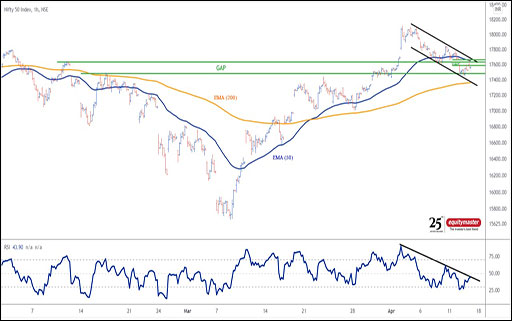
Apr 13, 2022
For intraday traders, the gap is filled at 17,530 level and the momentum may shift back to the higher levels towards 17,600-17620 zone.
![]() My September Trading Blueprint
My September Trading Blueprint

Aug 26, 2021
This is how you should trade in September.
![]() How the Taliban Changed our Markets
How the Taliban Changed our Markets

Aug 19, 2021
In this video, I'll show you the immediate impact of the Taliban on our stock market.
![]() Secret Hack of Millionaire Traders
Secret Hack of Millionaire Traders

Aug 10, 2021
Follow this simple hack to boost your intraday trading profits.
![]() What Ails the Market?
What Ails the Market?

Jul 8, 2021
Let me tell you why the bulls are finding it difficult to push the market higher.
![]() Why Did Shares of Divi's Lab Rally Today?
Why Did Shares of Divi's Lab Rally Today?

Jun 10, 2021
The stock jumped 3.6% in intraday trade to hit its 52-week high.
5 Intraday Trading Rules to Never Break
May 31, 2021
To become a better intraday trader, follow these rules religiously.
FAQs
What is the most successful intraday trading strategy?
There is no single strategy that is consistently successful in any form of trading, including intraday trading. Financial markets are dynamic. Traders all around the world are constantly learning and improving their knowledge and skills.
You will need to do the same. Stay up to date with charting techniques and keep learning all the time.
Soon you will be able to develop your own intraday trading strategy which will beat the market.
What is the secret of intraday trading?
The secret to day trading is simple. Follow a clear trading strategy.
You see, most intraday traders don't follow any strategy at all. They just 'read the tape' and hope for the best.
Or they trade in anticipation of some news that may move a stock intraday.
Rarely do they have a system to fall back on. If you have one, then you will immediately set yourself apart from 99% of intraday traders in the market.
Your intraday strategy must be based in the competent use of short-term technical charts. These will be 3, 5, 15, 25, and 75 minute charts. We suggest using Heikin Ashi candlestick charts.
You should also use technical indicators that are appropriate for intraday trading. The moving average convergence-divergence (MACD), average directional index (ADX), and Relative Strength Index (RSI) are three good choices.
Finally, always trade with a stop loss and follow sound money management principles.
Is intraday trading profitable?
Most intraday traders lose money. This is because they trade without a plan, without a strategy.
Many don't use stop losses. Often, they commit large amounts of capital in a single trade. In such situations, a single bad trade takes a big bite out of their trading capital which is hard to earn back.
To make consistent profits in intraday trading, you need to follow a sound trading strategy. This strategy should be built upon a good grounding in the fundamentals of technical analysis.
It will require some trial and error on your part. It will take some time. But once you have a winning trading strategy, intra-day trading will become profitable.
ABOUT EQUITYMASTER
Since 1996, Equitymaster has been the source for honest and credible opinions on investing in India. With solid research and in-depth analysis Equitymaster is dedicated towards making its readers- smarter, more confident and richer every day. Here's why hundreds of thousands of readers spread across more than 70 countries Trust Equitymaster.
PREMIUM PRODUCTS
QUICK LINKS
POPULAR TOPICS
- Multibagger Penny Stocks
- Basics of Value Investing
- Benjamin Graham
- How to Invest in Gold
- How to Invest in Silver
- Best Stocks to Buy Today
- Best Small-cap Stocks to Buy
- Best Bluechip Stocks to Buy
- Guide to Penny Stocks
- How to Invest in the Share Market
- Warren Buffett - The Value Investor
- Pick the Best Multibagger Stocks
TRENDING TOPICS


Copyright © Equitymaster Agora Research Private Limited.
Whitelist | Refer | Terms | Privacy | Contact | About | Sitemap

Equitymaster Agora Research Private Limited (Research Analyst)
SEBI (Research Analysts) Regulations 2014, Registration No. INH000000537.
103, Regent Chambers, Above Status Restaurant, Nariman Point, Mumbai - 400 021. India.
Telephone: +91-22-61434055. Email: info@equitymaster.com. Website: www.equitymaster.com.
CIN:U74999MH2007PTC175407
Name of the Compliance & Grievance Officer: Ms Sonal Ramachandran
Telephone: +91-22-61434003 | Email: compliance@equitymaster.com
LEGAL DISCLAIMER:
Investment in securities market are subject to market risks. Read all the related documents carefully before investing.
Registration granted by SEBI and certification from NISM in no way guarantee performance of the intermediary or provide any assurance of returns to investors.
All rights reserved. Any act of copying, reproducing or distributing this newsletter whether wholly or in part, for any purpose without the permission of Equitymaster is strictly prohibited and shall be deemed to be copyright infringement.
Equitymaster Agora Research Private Limited (Research Analyst) bearing Registration No. INH000000537 (hereinafter referred as 'Equitymaster') is an independent equity research Company. Equitymaster is not an Investment Adviser. Information herein should be regarded as a resource only and should be used at one's own risk. This is not an offer to sell or solicitation to buy any securities and Equitymaster will not be liable for any losses incurred or investment(s) made or decisions taken/or not taken based on the information provided herein. Information contained herein does not constitute investment advice or a personal recommendation or take into account the particular investment objectives, financial situations, or needs of individual subscribers. Before acting on any recommendation, subscribers should consider whether it is suitable for their particular circumstances and, if necessary, seek an independent professional advice. This is not directed for access or use by anyone in a country, especially, USA, Canada or the European Union countries, where such use or access is unlawful or which may subject Equitymaster or its affiliates to any registration or licensing requirement. All content and information is provided on an 'As Is' basis by Equitymaster. Information herein is believed to be reliable but Equitymaster does not warrant its completeness or accuracy and expressly disclaims all warranties and conditions of any kind, whether express or implied. Equitymaster may hold shares in the company/ies discussed herein. As a condition to accessing Equitymaster content and website, you agree to our Terms and Conditions of Use, available here. The performance data quoted represents past performance and does not guarantee future results.