

MEMBER'S LOGINX
| Invalid Username / Password | ||||||||
| Invalid Captcha | ||||||||
|
||||||||
| Sign Up | Forgot Password? | ||||||||
- Home
- Views On News
- Nov 16, 2024 - Best Hotel Stock: Indian Hotels vs EIH
Best Hotel Stock: Indian Hotels vs EIH
 Indian Hotels logo source: https://www.ihcltata.com/
EIH logo source: https://www.eihltd.com/
The Indian hospitality industry is set to grow at a compound annual growth rate (CAGR) of 10.5% over the next three years.
This means there will be an annual incremental demand of Rs 82 billion (bn) driven by weddings, tourism, foreign travel, meetings, incentives, conferences, and exhibitions (MICE).
To meet this growing demand, all hospitality players are ramping up their portfolios and increasing the number of rooms.
Of the many hospitality players, two major ones that benefit the most from this growth are Indian Hotels Company and EIH.
Both are major players in the luxury and upscale segment and have been witnessing strong growth post-COVID-19 lockdowns.
Let's compare these two players to see who has better financials and who could benefit the most due to the growth of the hospitality sector.
Business Overview
# Indian Hotels Company
Indian Hotels Company is one the leading hospitality companies in India.
It has a diverse portfolio of segments across luxury, upscale, and midscale segments across four continents, 12 countries, and over 100 cities.
The company operates its hotels across four main brands, namely, Taj, Vivanta, Seleqtions, and Ginger.
Apart from the hotel business, the company has several ancillary businesses, such as a gourmet food platform, airline catering, and renting out private properties and bungalows for travellers.
# EIH
EIH, a pioneer of luxury hotels in India, is the flagship company of the Oberoi group.
With over 6 decades of presence in the hospitality business, the company owns and manages premium luxury hotels and cruises under the Oberoi, Trident, and Maidens brands.
Apart from India, the company has a presence internationally in Indonesia, Mauritius, Egypt, and the UAE.
EIH's other businesses include catering to flights, restaurant and lounge operations at airports, air charter services, and cafes.
| Particulars | Indian Hotels Company | EIH |
|---|---|---|
| Market Cap (in Rs billion)* | 1,015.60 | 222.8 |
Between the two companies, Indian Hotels Company has a higher marketcap of Rs 1,015.6 billion (bn), as against Rs 222.8 bn of EIH.
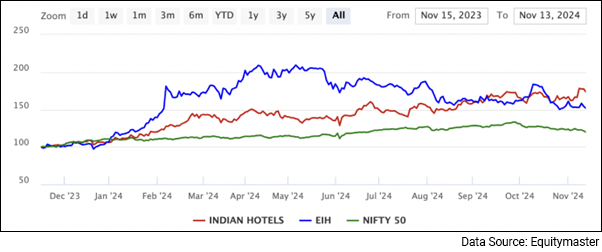
If we compare the two companies with respect to their performance on the stock market, then Indian Hotels Company is again leading with a 74% return in the last one year, as against 51% return for EIH.
However, both companies managed to beat the market index Nifty 50, which gave a return of 19% in the last year.
# Portoflio
Indian Hotels Company is leading with respect to the hotels it owns and manages. Indian Hotels Company owns and manages 311 properties at the end of March 2024. Out of these, 218 properties are operational, and 93 are in the pipeline.
In these 218 properties, the company has a total inventory of 24,136 rooms, with 12,953 rooms in the pipeline.
EIH, in contrast, owns and manages only 29 properties with an inventory of 4,269 rooms.
Apart from a big portfolio of hotels, Indian Hotels Company also enjoys a higher occupancy of 71%, as against 69% of EIH.
The average room rate (ARR) for Indian Hotels Company is Rs 7,200, as opposed to Rs 12,662 for EIH.
Clearly, Indian Hotels Company is leading with a strong portfolio of hotels and higher occupancy, whereas EIH has a higher ARR.
Hotels Owned and Managed
| Volume (in units) | Mar-20 | Mar-21 | Mar-22 | Mar-23 | Mar-24 |
|---|---|---|---|---|---|
| Indian Hotels Company | 200 | 221 | 235 | 263 | 311 |
| EIH | 30 | 30 | 30 | 30 | 29 |
# Revenue
The main source of revenue for Indian Hotels Company is from room rents, which constitute 49% of the income, followed by food and beverage (39%) and management fees (7%).
For EIH, the majority of the revenue is earned from room rents. However, flight catering and airport lounge business has been growing rapidly in the recent past.
In the last five years, the revenue of Indian Hotels Company grew by a compound annual growth rate (CAGR) of 8.7% on account of strong growth in hotels business, management fees, and its ama stays rental business.
For EIH, the revenue growth is slightly higher at 9.5%, which is accounted for by the higher ARR.
Both the companies witnessed strong revenue growth on account of growing domestic tourism, wedding market, and corporate travel.
Although EIH's revenue growth is higher, its absolute revenue is lower than that of the Indian Hotels Company.
This is primarily due to Indian Hotels Company's growing portfolio of hotels.
Going forward, the revenue growth for both the companies is expected to remain strong on account of growing ARR, and strong growth in the ancillary businesses.
Revenue
| Net Sales (in Rs m) | Mar-20 | Mar-21 | Mar-22 | Mar-23 | Mar-24 | 5-Year CAGR |
|---|---|---|---|---|---|---|
| Indian Hotels Company | 44,631 | 15,752 | 30,562 | 58,099 | 67,688 | 8.70% |
| EIH | 15,963 | 4,935 | 9,853 | 20,188 | 25,113 | 9.50% |
# Profitability
To assess the profitability of a company, we must look at the earnings before interest tax depreciation and amortisation (EBITDA) growth, net profit growth, and profit margins.
For Indian Hotels Company, the EBITDA and net profit grew by a CAGR of 16.3%, and 27.9% respectively.
Higher room rents on account of strong demand drove the profit growth. Moreover, the company's management fees, which it charges on managed hotels, have very high margins, which is helping the company grow its profits.
For EIH, the EBITDA and net profit grew by a CAGR of 23.1% and 32.6%, respectively. Given the company's higher room rents, and ARR, the profitability growth is on the higher side.
Moreover, EIH's profit margins are also higher than those of Indian Hotels Company.
The net profit margin averaged at 11.7% for EIH, as against, 9% for Indian Hotels Company.
Going forward, the margins are expected to improve further on account of higher demand.
Profitability
| EBITDA (in Rs m) | Mar-20 | Mar-21 | Mar-22 | Mar-23 | Mar-24 | 5-Year CAGR |
|---|---|---|---|---|---|---|
| Indian Hotels Company | 11,000 | -1,970 | 5,599 | 19,435 | 23,401 | 16.30% |
| EIH | 3,687 | -2,298 | 574 | 6,750 | 10,416 | 23.10% |
| PAT (in Rs m) | Mar-20 | Mar-21 | Mar-22 | Mar-23 | Mar-24 | 5-Year CAGR |
| Indian Hotels Company | 3,508 | -6,942 | -2,224 | 9,714 | 12,016 | 27.90% |
| EIH | 1,651 | -3,633 | -840 | 3,392 | 6,777 | 32.60% |
| Gross Profit Margin | Mar-20 | Mar-21 | Mar-22 | Mar-23 | Mar-24 | |
| Indian Hotels Company | 24.60% | -12.50% | 18.30% | 33.50% | 34.60% | |
| EIH | 23.10% | -46.60% | 5.80% | 33.40% | 41.50% | |
| Net Profit Margin | Mar-20 | Mar-21 | Mar-22 | Mar-23 | Mar-24 | |
| Indian Hotels Company | 7.90% | -44.10% | -7.30% | 16.70% | 17.80% | |
| EIH | 10.30% | -73.60% | -8.50% | 16.80% | 27.00% |
#Debt Management
Both Indian Hotels Company and EIH are debt-free companies.
Since EIH hasn't invested a lot in expanding its portfolio, the company has a low-debt and high asset base.
It also has high cashflows, which the company plans to use for its future projects.
EIH is currently building five huge luxury resorts in India and plans to build 6 more in India to expand its portfolio.
Indian Hotels Company, on the other hand, is actively investing in expanding its portfolio. It currently has 93 projects under work in progress, and plans to adopt an aggressive plan to boost its growth.
The company has been increasing its managed properties to earn high margin management fee. This could be the reason why Indian Hotels Company has been debt-free for the last two years.
Debt Management
| Debt to Equity Ratio (x) | Mar-20 | Mar-21 | Mar-22 | Mar-23 | Mar-24 |
|---|---|---|---|---|---|
| Indian Hotels Company | 0.5 | 0.6 | 0.2 | 0 | 0 |
| EIH | 0.1 | 0.1 | 0.1 | 0 | 0 |
# Financial Efficiency
Return ratios help assess how efficiently a company runs its business.
The two return ratios that are widely used are return on capital employed (RoCE) and return on equity (RoE).
The RoCE of Indian Hotels Company and EIH averaged 8.8% and 6.2%, respectively, in the last five years.
On the other hand, the RoE of Indian Hotels Company and EIH averaged 2.2% and 3.6%, respectively, in the last five years.
Both Indian Hotels Company and EIH are almost at par in terms of financial efficiency.
Financial Efficiency
| ROCE | Mar-20 | Mar-21 | Mar-22 | Mar-23 | Mar-24 |
|---|---|---|---|---|---|
| Indian Hotels Company | 11.40% | -7.60% | 2.00% | 18.40% | 19.80% |
| EIH | 6.60% | -12.60% | -1.50% | 14.60% | 23.80% |
| ROE | Mar-20 | Mar-21 | Mar-22 | Mar-23 | Mar-24 |
| Indian Hotels Company | 8.10% | -19.00% | -3.10% | 12.20% | 12.70% |
| EIH | 5.30% | -11.70% | -2.80% | 10.10% | 17.20% |
# Dividend
A company distributes its profits in terms of dividends to its shareholders.
A high and consistently growing dividend is considered a good sign as it indicates that the company's profits are stable.
Indian Hotels Company has consistently paid high dividends to its shareholders. In the last five years, the dividend per share of the company grew by a CAGR of 28.5%. The dividend yield and dividend payout averaged 0.4% and 4%, respectively.
Recently, the company announced that it plans to increase its dividend payout to 20-40% of the net profit in the coming financial years.
EIH started paying dividends in the financial year 2023. The dividend yield and dividend payout averaged 1.2% and 15.7%, respectively, in the last two years.
Although Indian Hotels Company has been more consistent in paying dividends to its shareholders, EIH has higher dividend yields.
Dividend
| Dividend Per Share (Rs) | Mar-20 | Mar-21 | Mar-22 | Mar-23 | Mar-24 | 5-Year CAGR |
|---|---|---|---|---|---|---|
| Indian Hotels Company | 50 | 40 | 40 | 100 | 175 | 28.50% |
| EIH | 0 | 0 | 0 | 1.1 | 1.2 | NA |
| Dividend Yield | Mar-20 | Mar-21 | Mar-22 | Mar-23 | Mar-24 | |
| Indian Hotels Company | 0.70% | 0.40% | 0.20% | 0.30% | 0.30% | |
| EIH | 0.00% | 0.00% | 0.00% | 1.10% | 1.20% | |
| Dividend Payout Ratio | Mar-20 | Mar-21 | Mar-22 | Mar-23 | Mar-24 | |
| Indian Hotels Company | 17.00% | -6.90% | -25.50% | 14.60% | 20.70% | |
| EIH | 0.00% | 0.00% | 0.00% | 20.30% | 11.10% |
# Valuation
To know the actual worth or intrinsic value of a company, we must look at its valuation ratios.
The two most widely used valuation ratios are price to earnings (P/E) and price to book value (P/BV). These ratios tell us whether a company is overvalued or undervalued.
The P/E of Indian Hotels Company and EIH are 63.4x and 36.8x, respectively, whereas the P/BV of the companies are 10.2x and 5.8x, respectively.
Clearly, Indian Hotels Company is very overvalued when compared to EIH.
However, if we compare the companies to their three-year averages, both the shares are undervalued. If we compare them to the industry average, Indian Hotels Company is overvalued, and EIH is undervalued.
| Valuations | Indian Hotels Company | 3-Year Average | EIH | 3-Year Average |
|---|---|---|---|---|
| PE (x) | 63.4 | 72.4 | 36.8 | 46.9 |
| PB (x) | 10.2 | 7.3 | 5.8 | 4.2 |
Which Hotel Stock is Better: Indian Hotels or EIH?
In terms of revenue growth, profit growth, and valuations, EIH is leading against Indian Hotels Company.
However, in terms of absolute revenue and profit numbers, gross profit margin, dividends, and hotel portfolio, Indian Hotels Company is way ahead of EIH.
Being a part of the Tata Group, the company enjoys the parent group's brand value.
Since starting its journey with a single hotel in 1903, the company now has over 300 hotels under its portfolio.
It has consistently made efforts to improve its business, and the same is reflected in its financials.
Recently, while announcing the Q2 FY25 results, the CEO said the company is planning to adopt a more aggressive growth strategy.
It plans to expand into the boutique hotel segment with the aim of increasing its revenue from management fees.
The company also plans to adopt a balanced approach to asset-heavy and asset-light portfolio growth to ensure it maintains its financial liquidity.
It recently acquired a stake in Tree of Life Resorts, targeting the untapped potential in India's hospitality market.
EIH, on the other hand, has stayed silent with respect to its portfolio expansion, but it is now aggressively investing in increasing its number of rooms.
It is currently building five huge luxury resorts in India, and plans to build 6 more in India to expand its portfolio.
Apart from this, it plans to focus on its air charter services, in-flight meals, and airport lounge business as it is seeing strong growth in these ancillary businesses.
EIH is also planning to revamp its existing properties to ensure it retains its status as a luxury hotelier and also focuses on domestic tourism.
Overall, the company aims to strengthen its market position and achieve robust financial performance in the financial year 2025 and 2026.
Given that there is strong growth in tourism, a growing middle-class population, increased business travel, and the government's initiatives to improve the country's infrastructure, the Indian hotel industry is set to experience double-digital growth.
Since Indian Hotels Company and EIH are two major hospitality players in the country, they are set to benefit from this growth.
However, it is important to note that these companies are in a cyclical industry and are affected by seasonal uncertainty.
Hence, it is important to proceed with caution when considering hospitality stocks as an investment.
Happy Investing!
Disclaimer: This article is for information purposes only. It is not a stock recommendation and should not be treated as such. Learn more about our recommendation services here.
ABOUT EQUITYMASTER
Since 1996, Equitymaster has been the source for honest and credible opinions on investing in India. With solid research and in-depth analysis Equitymaster is dedicated towards making its readers- smarter, more confident and richer every day. Here's why hundreds of thousands of readers spread across more than 70 countries Trust Equitymaster.
PREMIUM PRODUCTS
- Hidden Treasure
- Forever Stocks
- Big Wave Profits
- Equitymaster Venture
- Microcap Millionaires
- Momentum Profits
- Double Income
- Midcap Value Alert
- Exponential Profits
- Annual Breakout Alert
- Lazy Millionaire
- Phase One Alert
- InsiderPro Stocks
- StockSelect
- Private Briefing
- Active Wealth Multiplier 2030
- FundSelect
QUICK LINKS
POPULAR TOPICS
- Multibagger Penny Stocks
- Basics of Value Investing
- Benjamin Graham
- How to Invest in Gold
- How to Invest in Silver
- Best Stocks to Buy Today
- Best Small-cap Stocks to Buy
- Best Bluechip Stocks to Buy
- Guide to Penny Stocks
- How to Invest in the Share Market
- Warren Buffett - The Value Investor
- Pick the Best Multibagger Stocks
TRENDING TOPICS
- Best Defence Stocks in India
- Upcoming Dividend Stocks
- Best Semiconductor Stocks in India
- Data Center Stocks in India
- Best Railway Stocks in India
- Best Solar Stocks in India
- Fastest Growing Stocks in India
- List of BSE Sensex 30 Stocks
- Adani Group Shares
- Stocks Recently Bought by FIIs in India
- Top Value Stocks in India


LEGAL DISCLAIMER:
Investment in securities market are subject to market risks. Read all the related documents carefully before investing.
Registration granted by SEBI, enlistment with BSE as IA and RA, and certification from NISM in no way guarantee performance of the intermediary or provide any assurance of returns to investors.
All rights reserved. Any act of copying, reproducing or distributing any content from this website whether wholly or in part, for any purpose without the permission of Quantum Information Services Private Limited is strictly prohibited and shall be deemed to be copyright infringement.
Quantum Information Services Private Limited (QIS) is a SEBI registered Research Analyst (bearing registration no INH000021128) and Investment Adviser(Reg. No: INA000000680). Consequent upon the merger of Equitymaster Research Private Limited into QIS, effective October 30, 2025 QIS owns and operates brand 'Equitymaster' and website www.equitymaster.com. This does not constitute or is not intended to constitute an offer to buy or sell, or a solicitation to an offer to buy or sell financial products, units or securities and QIS including its employees, personnel, directors, associates will not be liable for any losses (direct or indirect) incurred or investment(s) made or decisions taken/or not taken based on the information provided herein. All content and information is provided on an 'As Is' basis by QIS. Information herein is believed to be reliable but QIS does not warrant its completeness or accuracy and expressly disclaims all warranties and conditions of any kind, whether express or implied. The services rendered by QIS are on a best effort basis. QIS does not assure or guarantee the user any minimum or fixed returns. The securities quoted, if any are for illustration only and are not recommendatory. Use of this information is at the user's own risk. The user must make his own investment decisions based on his specific investment objective and financial position and using such independent advisors as he believes necessary. This is not directed for access or use by anyone in a country, especially, USA, Canada or the European Union countries, where such use or access is unlawful or which may subject QIS or its affiliates to any registration or licensing requirement.
The performance data quoted represents past performance and does not guarantee future results. As a condition to accessing QIS's content and website, you agree to our Terms and Conditions of Use, available here
Equitymaster requests your view! Post a comment on "Best Hotel Stock: Indian Hotels vs EIH". Click here!
Comments are moderated by Equitymaster, in accordance with the Terms of Use, and may not appear
on this article until they have been reviewed and deemed appropriate for posting.
In the meantime, you may want to share this article with your friends!